Dive Brief:
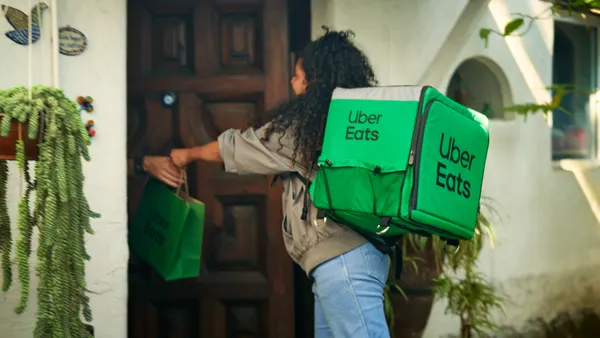
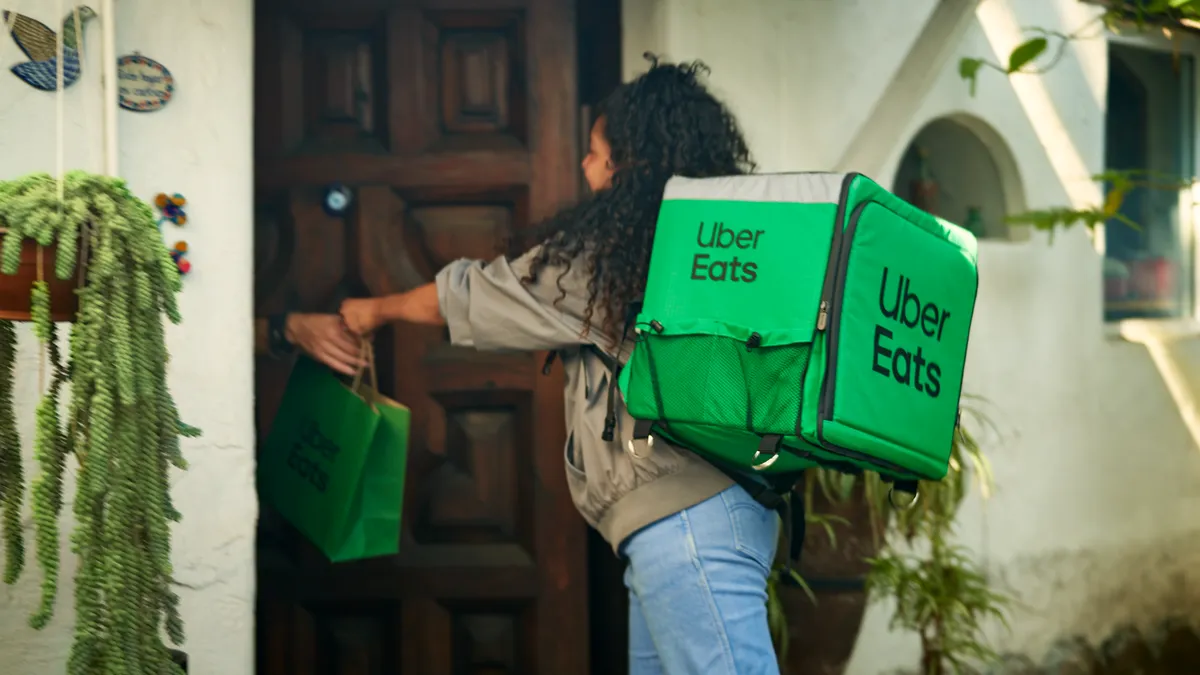
- Uber Eats has launched a returns service through its app, the delivery platform said in an email on Friday.
- In the app, users can select “return an item,” explain why they’re returning the product and choose “return with a courier” to send back eligible products. Users can instantly receive a refund for orders valued at $20 or more, and will pay a return fee based on the courier’s distance and time, the company said.
- Uber Eats is offering returns with multiple retailers across the country, including Best Buy, Dick’s Sporting Goods, Pacsun and Petco, with the intention of adding more partners in the future.
Dive Insight:
Building upon its previous relationships with retailers, Uber Eats seeks to make an otherwise cumbersome process more bearable for retailers and customers alike. The company expanded its retail partnerships in recent years, including offering same-day delivery with Dollar General, Pacsun and Lush. Now, the company is leveraging its logistics infrastructure for the returns process.
“Returns are one of the biggest pain points in retail, and we’re reimagining them the way only Uber can,” Rohan Mathew, engineering lead at Uber Eats, said in a statement. “Now, with just a tap, you can send an item back and get a refund without ever leaving home.”
As Uber Eats tries to simplify the returns process, research from the holiday season suggests that consumer returns are on the rise.
Though returns dipped 2.5% year over year between last Nov. 1 and Dec. 12, they were expected to grow 25% to 35% between Dec. 26 and Dec. 31, according to an Adobe Analytics report released in January. The report also predicted that returns would jump between 8% and 15% during the first two weeks of January.
In response to the rising demand, some retailers have changed their return policies over the past few years. In 2024, Walmart, for example, raised return shipping fees for third-party sellers and allowed its marketplace merchants to let customers keep items and receive refunds. That same year, REI said it stopped accepting returns from some of its users who had repeatedly abused its return policy.
As returns become a bigger strain on retailers’ bottom lines, some are using technology to identify bad actors. The National Retail Federation last fall predicted that retailers would receive almost $850 billion worth of returned merchandise in 2025. While the report estimates that 9% of returns are fraudulent, 85% of merchant respondents said they are using AI or machine learning to detect and fight fraud. However, only 45% of retailers say these tools are effective at doing so, the report found.